Brute Force: Alien Onslaught (Nolimit City) — a detailed review of features, respins, and payout logic
Brute Force: Alien Onslaught is Nolimit City’s sequel to the original Brute Force and, as of 2026, it is firmly positioned as an extreme volatility slot. The game is built around four character-based xNudge Wilds, a configurable RTP (which may vary depending on the casino’s chosen setting), and a bonus structure where the biggest outcomes come from sticky wild coverage and multiplier growth. Publicly available data for the title lists RTP up to 96.01% (operator dependent) and a maximum win of 80,000x the stake. These figures explain why many sessions can feel quiet for long stretches: a meaningful part of the theoretical return is concentrated in rare, feature-heavy win scenarios.
Core game setup: what happens before any bonus triggers
The slot runs on a 6-reel, 5-row grid and is commonly listed with 30 paylines. The visual theme is sci-fi action, but the mechanical focus is more important: the reels support stacked symbols and frequent wild interactions, which is exactly what allows the game to swing hard when the right sequence lands. In practice, Brute Force: Alien Onslaught often plays in two “moods” — long periods of small or moderate hits, followed by sudden bursts where wild nudges and multipliers quickly turn a standard spin into a strong return.
The RTP is not a single fixed value across every operator. Nolimit City is known for releasing multiple RTP configurations for the same game, and Brute Force: Alien Onslaught is widely referenced with a top RTP of 96.01%, while lower versions can exist depending on where you play. For players, this is not a minor detail: if you compare casinos in 2026, the RTP setting can affect the overall feel of the game, especially when you measure performance over long sessions.
The maximum win is publicly listed as 80,000x stake. It is important to read that number realistically. In games with this level of volatility, a max win is tied to very specific circumstances: strong wild coverage, high multipliers, and premium symbol connections across multiple reels. Most sessions will never come close to this ceiling, but it does clarify why the base game can be harsh — the mathematics reserves the largest payouts for rare setups.
Symbols and the win structure: why wild mechanics matter so much
The symbol set combines standard low-value card ranks with higher-value alien icons. The premium icons scale sharply when you connect them across enough reels, and that matters because the wild system is designed to support long symbol chains. In other words, you are not just chasing any win — you are chasing extended lines that become valuable once multipliers are applied.
One important detail frequently highlighted in published reviews is that wild behaviour can go beyond substitution. In some descriptions, wilds can convert low-paying symbols into higher tiers, which effectively increases the value of what would otherwise be an average spin. This mechanic is one reason the game can still produce decent mid-level hits even before the bonus round arrives.
Because of this structure, “good” spins are often shaped by wild presence rather than by raw symbol alignment. When character wilds nudge into a fuller position, they do two things at once: they increase reel coverage, and they improve the chance that multipliers are applied to meaningful symbol connections. That combination is what turns a standard outcome into a sharp payout spike.
xNudge Wilds: the main engine behind big outcomes
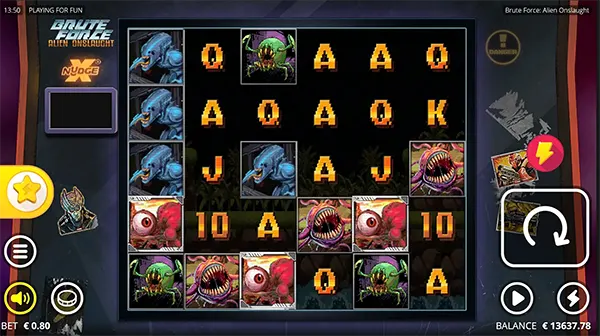
Brute Force: Alien Onslaught expands the xNudge Wild concept compared to the first Brute Force. Instead of relying on a single wild type, the sequel introduces four character-based xNudge Wilds, commonly referenced as Joshua, Jason, Jade, and Xylox. The key point is that these wilds do not behave like ordinary substitutes — they can land partially and then nudge into full reel visibility, creating stronger coverage and enabling larger symbol connections.
The practical effect is that big wins are rarely “one-and-done”. A typical strong sequence is built over a chain of events: a character wild lands, nudges, expands, and then contributes to multiplier-based calculations. When several of these behaviours overlap, the spin’s value can rise extremely fast, which explains why the slot’s payout curve feels so uneven across time.
This is also the reason bankroll management is more important here than in a standard slot. In a typical high volatility game, you are waiting for free spins. In Alien Onslaught, you can sometimes see the direction of a session earlier because xNudge wild behaviour in the base game can signal whether you’re in a stretch of low engagement or in a run where wild expansion and multiplier growth are actually happening with useful frequency.
Respins, sticky behaviour, and multipliers: how the slot builds “momentum”
When players and reviewers describe “respins” in this title, they are usually referring to sequences where a spin’s value is not decided immediately. Instead, the result develops through wild expansion and feature logic. In practical terms, this means that a spin can start modestly and then become meaningful once the game resolves the full wild and multiplier behaviour.
Sticky behaviour is particularly important in free spins, because persistent wild coverage is what turns a good symbol layout into a high multiplier payout. Many published breakdowns point to full-reel sticky xNudge wild setups as the foundation for the biggest possible outcomes. If you see sticky coverage established early, the bonus is far more likely to become profitable rather than merely returning a small fraction of the stake.
Another detail that makes the sequel feel different is the interaction between wild types. Some sources mention that Xylox can “steal” multipliers from the main characters, which implies that the strongest outcomes are often created by stacking wild interactions rather than relying on one character to do all the work. That design choice increases the range of possible bonus outcomes — from weak to extremely strong.
Free spins and payout scenarios: where the main return is formed
The slot includes multiple free spins variants, commonly described as five different modes. This is not just a cosmetic feature: each mode can affect how sticky wilds, nudges, and multipliers behave, which changes the entire shape of the bonus. In 2026, this multi-mode approach is one of the clearer reasons Alien Onslaught is viewed as a more complex and higher-ceiling title than the original Brute Force.
The most reliable indicator of a strong bonus is not simply the number of spins. It is early structure. If character wilds establish themselves quickly and nudges expand in a useful way, you’re no longer relying on random symbol alignment — you’re playing a bonus that already has a built-in advantage through persistent reel coverage and growing multipliers.
At the same time, it’s important to be realistic: this is not a slot where most bonuses will be large. Extreme volatility games are mathematically designed to produce many low or moderate bonus outcomes and a small number of very large ones. That is the trade-off that supports the 80,000x potential, and it explains why long “dry” runs are not only possible but expected.
How to read a bonus round: practical signals of weak vs strong outcomes
A weak bonus round usually looks predictable: limited wild presence, nudges that fail to expand meaningfully, and multiplier values that remain low. You may still see wins, but they tend to be driven by standard symbol hits rather than by the slot’s core engine. This is why a bonus trigger alone is not a guarantee of value.
A strong bonus round tends to show at least one clear sign early: a character wild nudges into a full or near-full position, sticky coverage locks key reels, or multipliers begin building fast enough that even mid-tier symbol connections become valuable. That “early momentum” is the difference between a bonus that ends quickly and a bonus that has room to snowball.
The top-tier scenario — the one capable of reaching huge multipliers and supporting the headline max win — is a combination of dominant sticky wild coverage, sustained multiplier escalation, and premium symbol connections across enough reels to exploit that multiplier properly. It is rare, but the entire game design is built around allowing that kind of chain reaction, which is why the volatility feels so extreme.